If you’re planning to swim this weekend, here’s the most important thing you can do before anyone jumps in:
Test your pool water now – not on the day.
Pool water changes constantly, especially in a NZ summer. Sun, rain, debris, parties… it all affects your pool chemistry fast. And once something tips out of balance, you’re suddenly fighting cloudy water, algae, irritation, or chlorine that won’t hold.
The good news?
A simple test – done at the right time – prevents nearly every common pool problem. Let’s break down exactly what to test, when to test it, and why it matters.
How Often Should You Test? (More Often Than You Think)
Weekly testing is the absolute minimum.
It takes under a minute and saves hours of troubleshooting later. But you should test even more often when:
- there’s been heavy rain (common in Canterbury’s “four seasons in one day” weather)
- the pool has had lots of swimmers
- temperatures have been 25°C+ for a few days in a row
- your chlorine keeps drifting down
- the water looks slightly “off,” even if still clear
- you’re about to have a gathering or pool party
In these situations, every 3–4 days is ideal.
And always test:
- before adding any chemicals
- after adding chemicals (to confirm they worked)
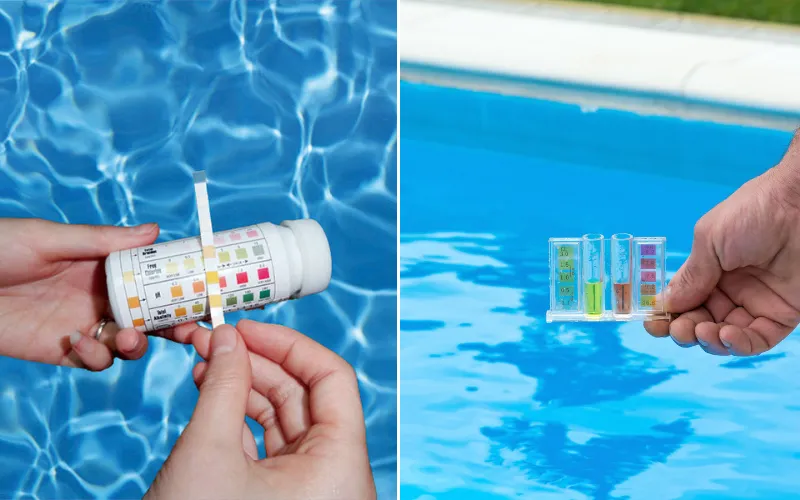
Test Strips vs Liquid Test Kits – What’s Better?
Both are good tools, but each has its place.
Test Strips
Perfect for:
- weekly routine checks
- fast, easy reads
- quick confirmation before swimming
- They’re simple, convenient, and surprisingly accurate for everyday maintenance.
Liquid Test Kits
Best for:
- when something’s not right
- algae issues
- cloudy water
- chlorine not holding
- stubborn pH drift
They give more detailed results and are ideal for diagnosing specific problems.
Best Practice:
Use strips weekly – use a liquid kit or bring us a sample for a free professional test whenever your water isn’t behaving.
The Big Three You MUST Check Weekly
These levels make or break your pool:
pH: 7.4–7.6
If pH is wrong:
- chlorine won’t work
- eyes sting
- skin gets irritated
- scale forms/etching occurs
- water looks dull and cloudy
- Alkalinity: 80–120 PPM
Think of alkalinity as the “shock absorbers” for your pH.
If it’s low, your pH bounces all over the place.
If it’s too high, you struggle to move pH at all.
Free Chlorine: around 3 PPM
This is your pool’s defence system.
If FC drops too low, algae jumps in fast — especially on hot days.
If FC is too high, it can irritate swimmers and bleach covers.
Other levels to track occasionally:
- Calcium hardness (don’t let it get too low – Christchurch water can be soft)
- Stabiliser (CYA) (essential for many outdoor pools, but don’t let it climb too high)
- Phosphates (food source for algae – manage if trending up)
But these don’t move quickly, so weekly checks aren’t necessary.
Why Testing Now Matters if You’re Swimming This Weekend
Pool chemistry doesn’t fix itself.
If chlorine is low on Saturday morning, it’s already too late – shocking the pool right before swimming delays swim time and wastes chemicals.
What testing early lets you do:
- correct problems gently before swimmers get in
- avoid last-minute major chemical adjustments
- prevent irritation, cloudy water, or algae
- keep chlorine and pH in the safe zone
- enjoy the weekend without scrambling
A quick check today = zero chaos on swim day.
Your Pool’s Cheapest “Insurance Policy”
Testing regularly is the easiest, lowest-cost way to keep your pool:
- clear
- healthy
- balanced
- algae-free
- inexpensive to run
- Skipping tests is what leads to expensive water problems – cloudy water, scaling, ruined filters, and those dreaded green pool emergencies.
Testing stops all of that before it starts.
If you bring a sample in to us, we’ll run a full computerised test and tell you exactly what to add in the right order. Simple, step-by-step, no guessing.
Enjoy the Swim Season – Start With a Quick Test
If you’re planning to swim this week or weekend, test today so everything is ready for splash-time. Or pop in with a sample – we’ll handle the rest.